
Sam Altman has insisted that we are close to creating a “genie that can grant any wish.” Tech giants tell us artificial intelligence may soon surpass human intelligence, eliminate entire categories of employment and perhaps even become an existential threat to humanity.
If that is really where we are, the evidence should be overwhelming.
Yet, how many films currently playing in cinemas are actually being made by AI rather than actors, directors, writers and production crews? Look at Bengaluru, one of the world’s largest technology centres. In Q2 2026 alone, the city added 5.8 million sq ft of new office supply, up 73% year-on-year. Gross office leasing was 5.6 million sq ft, with Global Capability Centres accounting for 52% of demand. Net absorption was another 3.5 million sq ft. These are strange numbers for a city supposedly teetering on the edge of mass white-collar obsolescence.

There is an enormous gap between the world we can observe and the world the AI industry keeps telling us is about to arrive. In February 2019, when OpenAI (where Dario Amodei served as Vice President of Research) decided to withhold the full weights of GPT-2, Dario and OpenAI stated that the model was “too dangerous” to release all at once. That was GPT 2.0. In 2019. Too dangerous to release.
AI itself is real. ChatGPT, Claude and similar systems are impressive tools. They can write code, summarise documents, analyse information, generate images and improve productivity in specific tasks. But useful software is not artificial general intelligence. And it definitely ain’t no trillion dollar business.
Today’s large language models are probabilistic systems trained to produce plausible outputs from patterns in data. The story being sold is much grander: that these systems are rapidly developing into a new form of intelligence capable of replacing vast amounts of human labour, transforming GDP and ultimately approaching superintelligence.
That is where the snake oil begins. The hyperbolic fear that artificial intelligence will become an uncontrollable, god-like superintelligence that destroys humanity—serves as a convenient financial and PR smokescreen for Big Tech oligarchs to deflect scrutiny from the industry’s shaky economic fundamentals
The economics certainly do not resemble those of an unstoppable technological revolution. OpenAI reportedly generated roughly $13 billion of revenue in 2025 against around $34 billion of costs and expenses. Research and development expenditure alone reportedly exceeded revenue.
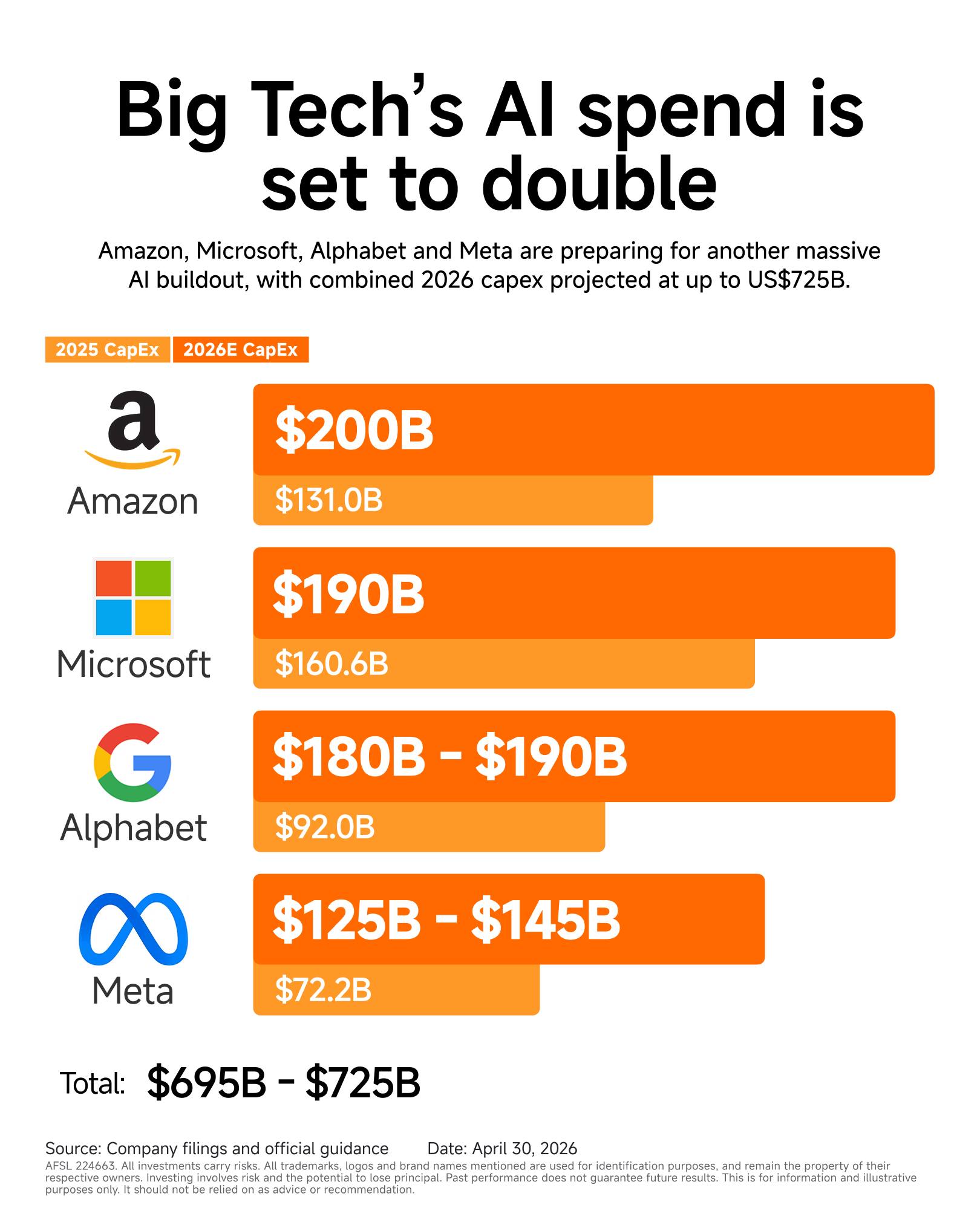
Meanwhile, Microsoft, Alphabet, Amazon and Meta are collectively guiding towards roughly $700 billion-plus of capital expenditure in 2026, much of it associated with the infrastructure required for AI and cloud computing.
The obvious question is: where are the returns?
Usage is not the same as economic value. AI also lacks one of traditional software’s greatest advantages. Conventional software can be developed once and distributed millions of times at negligible marginal cost. Generative AI requires meaningful computing resources every time someone asks it to perform a task.
The industry says those costs will decline, and they probably will. But cheaper computing is continually being consumed by larger models, longer context windows and increasingly compute-intensive “reasoning”. Falling unit costs therefore do not automatically mean improving economics.
Nor has scaling eliminated the technology’s fundamental weaknesses.
For years the implicit assumption was simple: more data, more parameters and more compute would continuously produce greater intelligence. Models have certainly improved, but hallucinations remain. Reliability remains inconsistent. Systems still confidently generate information that is completely false.
A human professional can make mistakes too, but that comparison misses the point. A competent human has context, accountability, institutional knowledge and some understanding of uncertainty. An LLM can produce a beautifully written falsehood without having any conception that it is false.
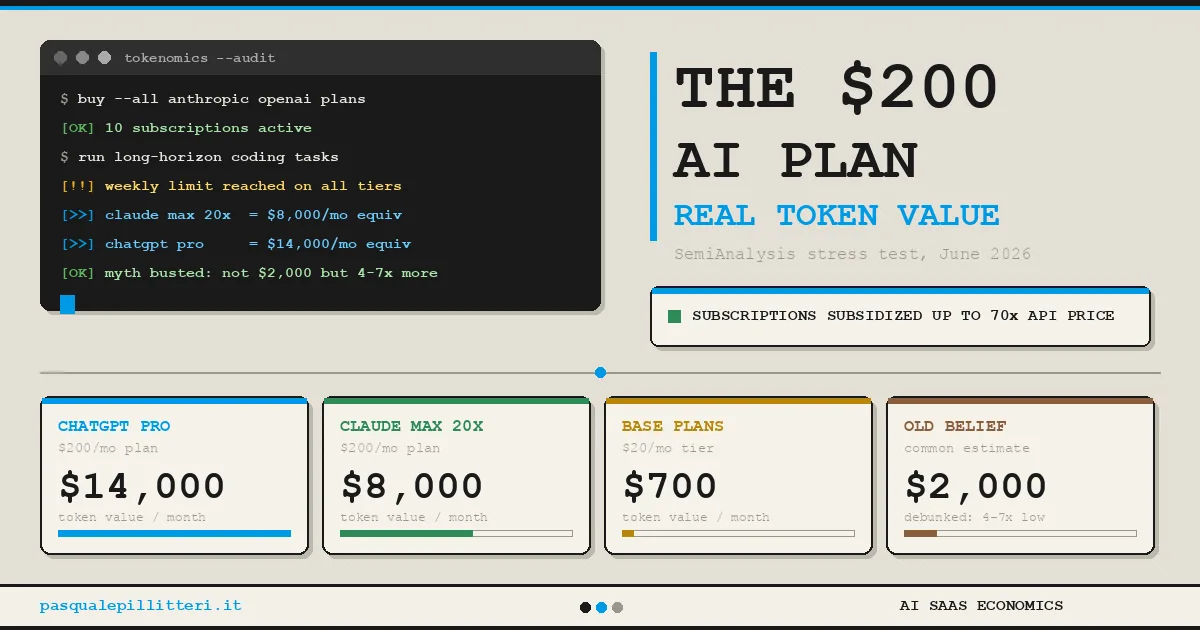
Then there is also an unusual subsidy embedded in AI usage. A SemiAnalysis stress test found that a user fully exploiting a $200-a-month ChatGPT Pro plan could consume the equivalent of roughly $14,000 of API-priced usage; the comparable figure for Anthropic’s $200 plan was around $8,000. These are API-price equivalents rather than the companies’ actual compute costs, and ordinary users consume much less, but they illustrate how different AI economics can be from traditional software.
Yet remarkably, the technology’s shortcomings have helped create an even more powerful marketing narrative: AI doomerism.
The optimist tells us AI will create unimaginable abundance.
The doomer warns that AI could become so powerful it destroys humanity.
These sound like opposite positions. They are not. Both require us to accept the same central proposition: AI is rapidly becoming extraordinarily powerful.
That makes doomerism extraordinarily useful to an industry whose present-day economics struggle to justify the capital being invested.
If someone says their technology could potentially destroy civilisation, it sounds like a warning. But it is also perhaps the greatest product advertisement ever devised. Today’s losses, hallucinations and questionable returns can all be dismissed because something almost godlike is supposedly emerging underneath them.
And I suspect doomerism will eventually perform an even more useful function.
The current AI capex boom cannot continue indefinitely if adequate returns fail to materialise. At some stage hyperscalers may have to slow investment.When that happens, do not expect many executives to say: “We overbuilt. The returns weren’t there. We dramatically overestimated the economic potential of the technology.” Our prediction is that doomerism will provide part of the narrative cover.
The language will shift towards responsible development, safety, social disruption, alignment and the danger of moving too quickly. A capex slowdown driven substantially by economics can be presented instead as technological prudence. It is an almost perfect narrative. Spend hundreds of billions because AI is unbelievably powerful. Then, if returns disappoint, slow spending because AI is unbelievably powerful.