

Indian equity markets may be entering a year where the headline index tells only half the story. The Nifty 50 has recovered from volatility and remains a strong representation of India’s largest businesses, but the next phase of market leadership may not come from the same narrow set of large-cap names that dominated previous cycles.
At Arunasset, we believe the coming year could increasingly become a tale of two halves: stable but more measured returns from large caps, and stronger earnings-led opportunities in select small and broader-market companies.
The reason is not simply that small caps have corrected or that they appear optically attractive after periods of underperformance. The stronger argument is structural. India’s growth cycle is becoming more domestic, more capex-oriented and more manufacturing-led. This matters because the Nifty Smallcap 250 has a very different sector composition from the Nifty 50. As per NSE’s latest factsheet, the Nifty Smallcap 250 has meaningful exposure to financial services, healthcare, capital goods, auto components and chemicals. Capital goods alone has a 13.11% weight, while healthcare is 13.84% and auto components are 8.45%. In comparison, the Nifty 50 is far more concentrated in financial services, oil & gas, IT and a handful of large incumbents, with capital goods at only 1.35%.
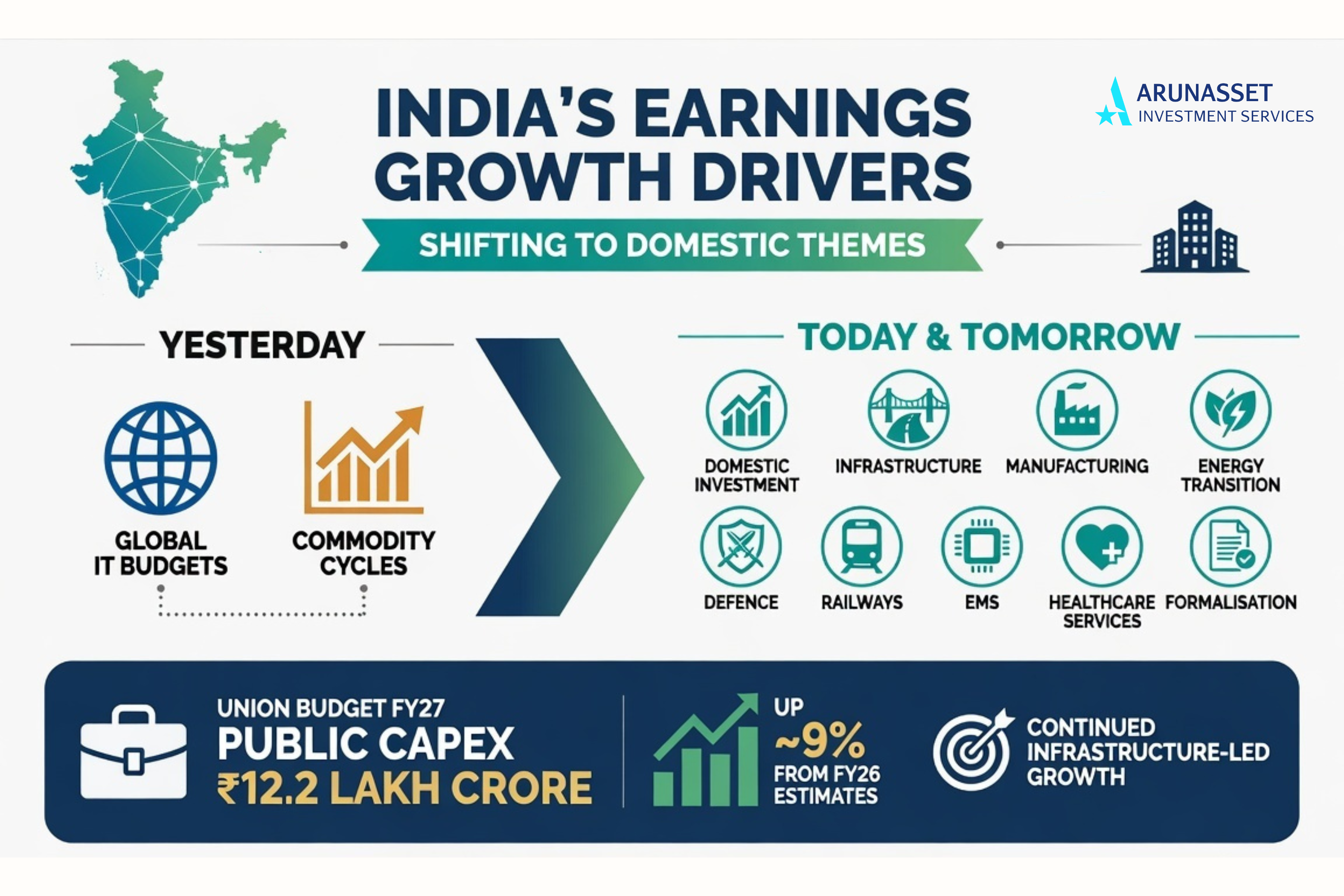
This composition difference is important. The next leg of India’s earnings growth is likely to be driven less by global IT budgets or commodity cycles and more by domestic investment, infrastructure, manufacturing, energy transition, defence, railways, EMS, healthcare services and formalisation. Many of these themes are represented more deeply in the broader market than in the Nifty 50. The Union Budget’s public capex allocation of ₹12.2 lakh crore for FY27, up around 9% from FY26 budget estimates, reinforces the government’s continued push towards infrastructure-led growth.
The capital goods cycle is one example of this shift. CRISIL expects the capital goods sector to sustain 12–14% revenue growth, supported by stronger order books. The sector’s book-to-bill ratio has reportedly improved to around 3.7x in FY26 from 3.1x in FY24, giving reasonable visibility to revenue growth over the next few years. This is precisely the kind of environment where well-run small and mid-sized companies can see operating leverage play out. When revenues grow faster than fixed costs, even a moderate rise in sales can translate into much stronger growth in profits.

Earnings data also suggests that the market is broadening. In Q3FY26, HDFC Mutual Fund’s earnings review noted that Nifty 500 earnings grew 14% year-on-year, with large caps growing 12%, midcaps 16% and small caps 25%. It also noted that large-cap profit share in the Nifty 500 had declined from 78% in Q3FY23 to 74% in Q3FY26, pointing to a broader earnings base. Q4FY26 was more mixed, with small-cap earnings growth at 8.5% and large caps at 9.6%, while midcaps were the clear standout at 40.7%. But even this reinforces the central point: the earnings story is no longer restricted to the largest companies.
There is also a macro tailwind. The RBI’s repo rate is now at 5.25%, and the policy environment has moved away from the very tight liquidity conditions that hurt smaller companies disproportionately. Lower borrowing costs, better liquidity and improving demand tend to help smaller businesses more because they are more sensitive to working capital costs and domestic credit availability.
However, being positive on small caps does not mean being indiscriminate. Valuations are not cheap across the board. The Nifty Smallcap 250 was trading at a P/E of 33.67x in the latest NSE factsheet, compared with 20.58x for the Nifty 50. That valuation gap means stock selection matters. The opportunity is not in buying everything that has a small-cap label. It is in identifying companies where earnings visibility, balance-sheet strength, governance and sector tailwinds justify the valuation.
This is also why Arunasset has restructured portfolios to increase exposure to select small-cap and broader-market opportunities. We are not treating this as a speculative trade. We see it as an earnings-cycle allocation. The objective is to participate in companies that are better aligned with India’s domestic capex, manufacturing and formalisation cycle, while avoiding weaker businesses where valuations are running ahead of fundamentals.
In our view, the coming year may reward investors who look beyond the index headline. Large caps will continue to provide stability, liquidity and core portfolio strength. But the sharper earnings acceleration may come from the second half of the market — the companies below the headline indices that are more directly exposed to India’s internal growth cycle. For investors with the right time horizon and risk tolerance, small caps deserve a larger, but carefully selected, place in portfolios.